
- Home
- EventsEvents
- Product Launches
- CategoriesCategories
- Advertise
- Opinion

Every year, World Environment Day sharpens the global conversation around climate action and environmental sustainability. In India, that conversation is becoming increasingly urgent for agriculture – a key sector that shapes the country's food security and the livelihoods of hundreds of millions of people. The challenge is not only how to farm more sustainably, but how to help smallholder farmers responsibly and efficiently apply crop inputs without risking productivity or income stability.
Fertiliser use in India has risen nearly nine-fold since the Green Revolution, making the country one of the world’s largest consumers[1]. But decades of intensive cultivation are now depleting soil fertility, raising input costs, and leaving farmers increasingly vulnerable to erratic rainfall and shifting growing seasons.
Yet the transition to more sustainable farming practices is far from straightforward. For many farmers whose livelihoods depend on every harvest, the risks of shifting away from familiar, fertilizer-intensive methods carry very real consequences. What many smallholder farmers across India lack is access to locally relevant, science-backed guidance they can trust and practically apply.
Integrated nutrient management (INM) and integrated pest management (IPM) practices offer a well-evidenced pathway forward, but translating that evidence into farm-level action requires sustained, on-ground engagement. Increasingly, that role is being taken on by a new generation of agricultural researchers working directly alongside farming communities to translate scientific knowledge into real-world results.
The Rise of a New Generation of Agri Scientists
Pratiksha Balasaheb Khedkar is one such researcher. A PhD student from the Department of Entomology at Vasantrao Naik Marathwada Krishi Vidyapeeth in Parbhani, she has spent her fellowship years not only conducting field trials, but also publishing research in Scopus-indexed journals, presenting at national and international conferences, and working directly with farming communities in Maharashtra's Latur district. Her work focuses on biological pest control and integrated pest management, approaches that reduce dependence on pesticides by working with natural systems.
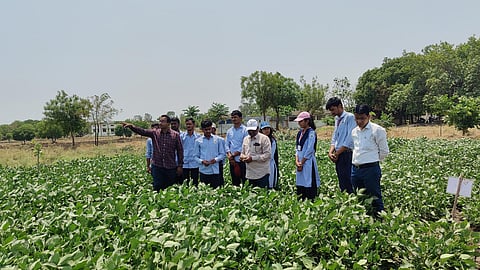
In practice, this means helping farmers understand not just what changes to make, but why those changes matter for long-term productivity and resilience. Through farmer education sessions, pest monitoring demonstrations, and lectures at Krishi Vigyan Kendras (KVKs), she has helped communities build confidence in more sustainable farming approaches. She has extended this work further through women empowerment initiatives, running sessions for women farmers on sustainable pest management, and through popular science articles published in Agrowan (Sakal), broadening the reach of sustainable agriculture knowledge across Maharashtra.
"Sustainable agriculture becomes stronger when integrated pest management is effectively implemented in the field,” she notes. “By empowering farmers with knowledge, we cultivate a safer, stronger, and more resilient future”, said Pratiksha.
This hands-on approach is shared by others in the cohort. Sushant Birajadar, an M.Sc. Agriculture student in Entomology also supported through the ADM Cares fellowship, has been focused on the practical execution of the “Phased Transition of Farmers to Integrated Approach” project. Working across farmer interactions, field demonstrations, and data collection, he describes the experience as having given him direct exposure to the realities of sustainable farming at ground level.
Sushant added, “Watching farmers grow in confidence as they take on integrated approaches and seeing the results bear out in their own fields is what makes this work meaningful. When that knowledge takes root at farm level, it doesn't just improve yields. It builds the foundation for a more resilient farming community.”
Scaling Sustainable Agriculture Through Partnerships
That impact is already visible at farm level. Farmer Dayanand Suresh Jadhav from Karla village in Latur district had previously struggled with low yields and declining soil fertility, without a systematic approach to pest management. After participating in the ADM Cares programme's training and field demonstrations, he implemented INM and IPM practices, including recommended fertiliser application methods and improved pest and disease management practices. The result was a 13% increase in production alongside meaningful reductions in input costs, achieved within just three to four months.
His experience reflects a broader pattern. The ADM Cares partnership with the College of Agriculture, Latur, which ran from 2021 to 2024, reached more than 5,000 farmers through over 150 training sessions and field engagements, emphasising gradual and practical adoption over time. The programme is an example of what becomes possible when industry partnership, academic research, and local trust-building work in sustained combination, and a marker of how community-level engagement makes sustainable farming adoption not just possible, but practical and enduring.
Scaling this approach across India’s diverse smallholder farming landscape will require sustained investment in agricultural research, extension infrastructure, and long-term partnerships between industry, academia, and farming communities. The foundation is already being laid by a new generation of agricultural scientists bringing research beyond the laboratory and into the field, proving that sustainable farming can be both practical and lasting.
By Amrendra Mishra, Managing Director of Ag Services & Oilseeds and Country Manager India, ADM
[1] Fertilizer and Pesticide Use in Indian Agriculture: Trends and Implications, 2025
Click HERE to subscribe to our FREE Weekly Newsletter
