
- Home
- EventsEvents
- Product Launches
- CategoriesCategories
- Advertise
- Opinion

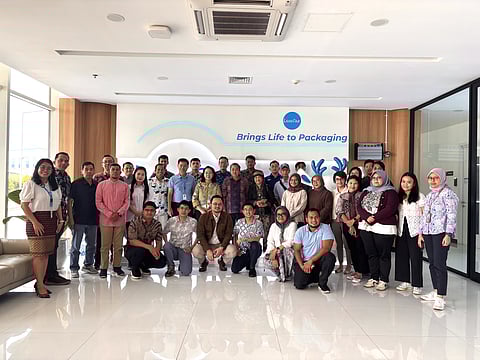
As part of its commitment to supporting the development of the national industry, PT Lami Packaging Indonesia (LamiPak Indonesia) shared insights and expertise with members of the Indonesian Food and Beverage Association (GAPMMI) through a discussion session held at its manufacturing facility in Cikande. The session served as a platform for exchanging perspectives on industry trends and exploring packaging solutions to address current market challenges. The session was also attended by Merrijanti Punguan Pintaria, Director of the Beverage, Tobacco, and Refreshment Industry at the Ministry of Industry.
Amid global dynamics affecting raw material supply chains, the food and beverage industry is increasingly required to adopt packaging solutions that are not only adaptive but also capable of delivering long-term competitive advantages. In this context, paperboard-based aseptic packaging is becoming increasingly relevant as a strategic alternative to preserve product quality without preservatives, enable more flexible distribution, and support more sustainable industry practices.
Adhi S. Lukman stated that the workshop is important to explore alternative solutions so that the food and beverage industry can continue to grow. Previously, aseptic packaging relied on a single supplier, and he expressed appreciation for LamiPak’s investment in Indonesia. What was once dependent on imports can now be fulfilled domestically.
“In responding to the current situation, there are two key aspects to consider: procurement and manufacturing. The manufacturing division needs to improve efficiency to remain competitive, while procurement needs to expand sourcing. This visit is also part of our effort to identify alternative packaging sources,” he added.
Merrijanti stated that the Ministry of Industry supports the domestic beverage industry in continuing to innovate and adapt to various challenges while strengthening competitiveness, one of which is through the use of sustainable packaging. She also expressed hope that the workshop would provide valuable insights to help industry players remain resilient amid ongoing global uncertainty, with aseptic packaging serving as a complementary solution for beverage producers in Indonesia.
“It is important to consider that the cost of paper-based aseptic packaging is not directly comparable to plastic packaging, and may differ in relative terms. However, when evaluated holistically, the overall outcome can be comparable, as aseptic packaging does not require cold chain distribution or refrigeration for storage, and its paper-based raw materials tend to be more stable,” she added in her remarks during the workshop.
“We believe the industry requires packaging solutions that not only address current challenges but also strengthen future competitiveness. Through aseptic packaging, we aim to contribute to a more adaptive and sustainable beverage industry,” said Hongbiao Li, LamiPak Indonesia’s Managing Director.
During the session, LamiPak Indonesia highlighted the key advantages of aseptic packaging, including its ability to maintain product quality and safety without the need for a cold chain, as well as enabling broader and more flexible distribution. Innovations such as paper straws were also presented as part of the company’s efforts to deliver more environmentally friendly packaging solutions.
National demand for aseptic packaging is estimated at around 8,3 billion packs per year, with approximately 4.8 billion coming from the dairy segment, and the remainder from tea- and coffee, plant-based beverages such as; coconut milk, oat milk dan mung beans. As the first aseptic packaging manufacturer in Indonesia, LamiPak has a production capacity of up to 21 billion packs per year, equivalent almost to three times national demand, enabling the company to support a more stable domestic supply while reducing reliance on imports.
In line with global trends, sustainability remains a key focus. LamiPak Indonesia continues to advance various environmental initiatives, including its Net Zero Carbon roadmap, as part of its contribution to driving a more responsible industrial transformation. The company also shared information on available government incentives, particularly those supporting manufacturers in upgrading and modernizing their production technologies.
Through this initiative, LamiPak Indonesia aims to continue serving as a strategic partner for the food and beverage industry in navigating global dynamics, while supporting the transition toward more innovative, reliable, and sustainable packaging solutions.
Click HERE to subscribe to our FREE Weekly Newsletter
