
- Home
- EventsEvents
- Product Launches
- CategoriesCategories
- Advertise
- Opinion

The Indian snack industry is undergoing a fundamental transformation—one that blends centuries-old culinary traditions with advanced food science, automation, and compliance-driven manufacturing. This shift was prominently showcased at Indusfood Manufacturing 2026, where industry leaders convened to define a clear roadmap for scaling Indian snacks into globally competitive, ready-to-eat (RTE) products.
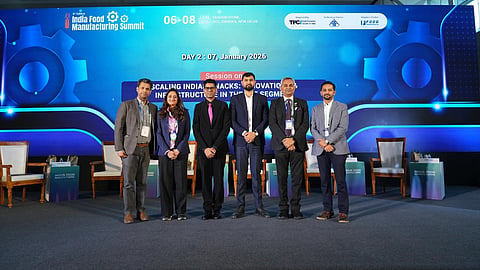
The strategic session, “Scaling Indian Snacks: Innovations and Infrastructure in the RTE Segment,” was chaired by globally renowned Food Technologist Bhushan Namdeorao Yengade, Founder of Binder Technology Consultancy. Discussions highlighted how success in international markets now depends as much on engineering precision, ingredient standardization, and hygienic design as on flavor authenticity.
Indian Snacks Enter a Phase of Scientific Reinvention
Presenting findings from his recent Asia-Pacific market study, Yengade described a decisive shift in global snacking behaviour—from impulse-driven consumption to what he termed “mindful indulgence.” He noted that the post-COVID era has significantly reshaped consumer expectations, with health, transparency, and functionality becoming central to product choice.
“Today’s consumers demand bold, traditional flavors—but without compromise on health,” Yengade explained. As the Vice President (Market Research) of Council for Promotion, Research & Trade in Traditional Foods, he mentioned the rising preference for high-protein, clean-label, and nutritionally transparent snacks is driving what he called, “Tradition 2.0,” where heritage foods are re-engineered using modern food science.
Engineering Scale: Infrastructure as the Growth Enabler
The panel brought together leaders from across food processing, ingredient manufacturing, and equipment engineering, all of whom stressed that scalability is now an infrastructure challenge rather than a culinary one.
Nishant Bansal, Managing Director of Noida Fabcon, identified material handling, thermal process stability, and packaging automation as the most common bottlenecks during scale-up. “When brands expand beyond regional production, the real constraints emerge in feeding, conveying, and process consistency—not in recipes,” he observed.
Ingredient Science and Consistency
Highlighting the critical role of base ingredients, Avanti Murarka, Managing Director of Crown Flakes Pvt. Ltd., discussed the growing adoption of dehydrated potato ingredients in scaled snack formats. As volumes increase, he said, batch-to-batch uniformity becomes non-negotiable. Precise control of hydration characteristics, granule size distribution, and texture is essential to ensure predictable performance on high-speed forming and frying lines.
Standardizing Street Foods for Global FMCG Markets
Addressing the challenge of converting street foods into export-ready products, Jayesh Patel, Managing Director of A Innovative Food Products (SharEat), shared insights from scaling formats such as pani puri kits. “Preserving authenticity is critical, but international markets have zero tolerance for microbiological deviations or allergen cross-contamination,” Patel warned.
He emphasized the need for recipe engineering, standardized masala processing, automated packing, and rigorous moisture control to ensure shelf-life stability and regulatory compliance across geographies.
Hygienic Design and Material Handling
Chetan Dakhore, Managing Director of Shri Vibracion Technologies, highlighted that material handling often determines overall plant hygiene and product integrity. Issues such as breakage, seasoning loss, and dust generation can significantly affect both yield and brand perception.
Dakhore advocated vibratory conveying systems designed specifically for fragile snacks like puffs and flakes, focusing on easy cleanability, dust containment, and strict segregation to prevent flavor and allergen cross-contamination.
Advances in Frying and Thermal Processing
Showcasing innovations in thermal processing, Krishna Pandit, CEO and Managing Director of Fry & Bake Technologies, demonstrated how direct-heating systems and continuous oil filtration are helping manufacturers align with global health and sustainability standards. These systems, he noted, not only reduce oil degradation and consumption but also improve product crispness and nutritional profile.
A Scientific Vision for 2030
In his concluding remarks, Yengade emphasised that technology must be driven by a clear strategic vision. “Our goal is not merely to scale volumes, but to position India as a global centre for healthy, science-led food innovation,” he said.
The consensus at Indusfood Manufacturing 2026 was unambiguous: the Indian snack sector has moved beyond incremental growth. By integrating advanced processing technologies, robust quality systems, and data-driven innovation—while retaining the essence of traditional flavors—India is well poised to emerge as a global leader in the ready-to-eat snack category.
Click HERE to subscribe to our FREE Weekly Newsletter
