
- Home
- EventsEvents
- Product Launches
- CategoriesCategories
- Advertise
- Opinion

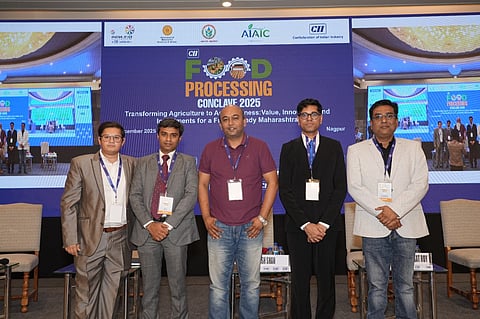
The CII Food Processing Conclave 2025, held in Nagpur, brought together policymakers, investors, scientists, and entrepreneurs. A key highlight of the conclave was the panel discussion titled “Innovation, Technology & Startups Driving the Future of Food,” where experts explored the role of emerging technologies and advanced packaging in transforming agriculture and food processing.
The conclave was inaugurated by Maharashtra Chief Minister Devendra Fadnavis, who emphasized the state's commitment to strengthening agribusinesses and food processing. Fadnavis described Maharashtra’s farmers as natural entrepreneurs and highlighted that access to finance, structured capacity building, and value-added opportunities like food processing units are crucial for significantly increasing farm incomes. The curtain raiser of AI4AGRI 2026 GLOBAL AI was unveiled.
Setting the Stage for Food Innovation
The panel discussion was moderated by Jinesh Shah, Managing Partner at Omnivore Capital, who set the stage by outlining the challenges the food industry faces today. Shah pointed out that changing consumer preferences, increasing demand for nutritious and protein-rich foods, shorter delivery timelines, and complex supply chains require the food sector to evolve quickly. He noted that modern consumers have higher expectations, demanding faster service, better quality, and more sustainable practices.
The panel featured four key industry leaders: Dr. S S Roy from ICAR’s Central Citrus Research Institute, Darshan Bhoot, Director – Operations at MDA Agrocot, Jigar Vora, Founder of Unnati Foods, and Bhushan Yengade, Food Technologist and Founder of Binder Technology Consultancy. Each panelist brought a unique perspective on food innovation, with a strong focus on agriculture, food processing, packaging, and market-driven solutions.
AI and Technology in Agriculture
Dr. Roy spoke about the importance of horticulture, particularly citrus, in increasing farmers’ incomes. He stressed that innovation should focus not just on boosting production but also on reducing post-harvest losses through improved storage, processing, and value addition. He pointed out that the key to sustainable growth in agriculture is creating solutions that are socially acceptable, easily adoptable, and market-oriented.
Darshan Bhoot, representing MDA Agrocot, highlighted how AI, IoT, and automation are transforming the food production and processing sectors. He explained that AI applications range from soil testing and crop planning to harvesting, sorting, quality testing, and export readiness. These innovations, Bhoot noted, help reduce wastage, ensure consistency, and optimize efficiency across the entire value chain, benefiting both farmers and food processors.
The Role of Food Processing in Reducing Wastage
Jigar Vora from Unnati Foods talked about how food processing helps reduce wastage and extend the shelf life of agricultural products. He shared examples of dehydration processing techniques that turn surplus or perishable produce into high-value, stable products. This, he explained, not only meets domestic demand but also opens up new markets globally, contributing to both food security and economic growth.
The Future of Food Processing and Sustainability
Bhushan Yengade who is consulting Food Processing Startups, brought a fresh perspective to the discussion by focusing on the often-overlooked role of packaging in food innovation. Yengade argued that packaging is much more than a method of wrapping products; it plays a crucial role in preserving food quality, extending shelf life, and ensuring faster product movement through the supply chain. He pointed out that as consumer expectations shift, packaging must evolve to meet new standards of quality, sustainability, and efficiency.
Yengade emphasized the importance of advanced packaging technologies like modified atmosphere packaging (MAP) and temperature-controlled systems. These technologies are essential for preserving the freshness, color, fragrance, and nutritional value of fruits and vegetables. Improved packaging, he explained, helps reduce food losses during transportation, supports a circular economy by minimizing waste, and ensures that food reaches consumers in optimal condition. He also addressed the growing focus on sustainability in the food sector and Binder Technology's research on Gen Z's packaging acceptance.
Technology, Entrepreneurship, and the Future of Food
The panel wrapped up with closing remarks from all the speakers, who agreed that technology and entrepreneurship will be central to the future of food. Jinesh Shah summed up the discussion by noting that with changing consumer demands, the rise of protein-rich diets, and the need for faster delivery, the food supply chain must evolve to meet both domestic and international markets.
The panel discussion at the CII Food Processing Conclave 2025 highlighted that the future of India’s food ecosystem lies at the intersection of science, startups, smart policy, and sustainability. As the world demands higher quality, fresher, and more sustainable products, packaging will undoubtedly play a leading role in shaping the future of food.
Click HERE to subscribe to our FREE Weekly Newsletter
