
- Home
- EventsEvents
- Product Launches
- CategoriesCategories
- Advertise
- Opinion

India’s frozen food market is entering a new phase of structured growth, driven by evolving consumer preferences, rapid urbanization, and expanding foodservice demand. In this context, the partnership between Cargill and McCain Foods marks a significant step toward building a resilient, sustainable, and innovation-led frozen food value chain in the country.
Speaking about the collaboration, Dheeraj Talreja, Vice President and Managing Director, Food South Asia, Cargill, and Mainak Dhar, Managing Director, McCain Foods India, outlined how the alliance is designed to strengthen quality standards, sustainability, and long-term category growth.
Building the next phase of frozen food growth in India
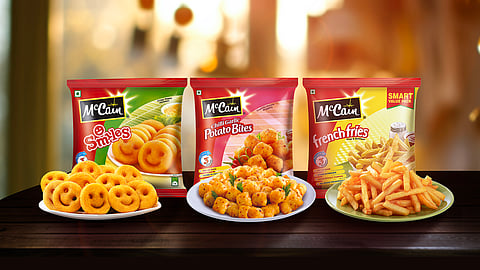
The partnership combines McCain’s global leadership in frozen potato products with Cargill’s deep expertise in ingredients, food safety, and supply chain management.
Mr. Mainak Dhar emphasized, “This partnership brings together McCain’s global leadership in frozen potato products and Cargill’s deep expertise in ingredients, food safety and supply chains. Together, it strengthens the ecosystem for high-quality, safe and scalable frozen foods in India, supporting the category’s next phase of growth.”
The collaboration is aimed not just at expanding volumes but at building a stronger ecosystem that ensures consistent quality, traceability, and scalability for India’s growing frozen food segment.
Advancing sustainability from farm to factory
Sustainability forms a central pillar of the partnership. Both companies share a commitment to responsible sourcing, resource efficiency, and regenerative agricultural practices.
Mr. Dhar noted, “Both companies share a strong commitment to sustainable sourcing, resource efficiency and responsible operations. The collaboration enables knowledge-sharing on regenerative agriculture, water and energy efficiency, and supply-chain optimization to reduce environmental impact from farm to factory.”
Adding to this, Mr. Talreja highlighted Cargill’s sustainability credentials, “Cargill supports sustainability by supplying RSPO-certified segregated oil and by applying strong standards in sourcing, traceability, and food safety. The collaboration also enables ongoing discussions around product formulation improvement, innovation, efficient resource use, and future-ready oil solutions.”
Through this combined expertise, the companies aim to reduce environmental impact while strengthening responsible sourcing frameworks.
A shared long-term vision for India
The long-term ambition of the alliance goes beyond immediate business gains. It focuses on building a future-ready frozen food value chain.
Mr. Dhar and Mr. Talreja jointly stated, “The long-term vision is to build a resilient, sustainable and future-ready frozen food value chain in India. This includes supporting farmer livelihoods, strengthening local manufacturing and innovative capabilities, and delivering consistent, high-quality products to Indian consumers.”
This vision underscores the importance of farmer engagement, local manufacturing strength, and innovation as foundational pillars.
R&D as a core driver of innovation
Research and development plays a central role in ensuring continuous product and process improvement.
Mr. Dhar explained, “R&D is a core pillar of partnership, enabling product innovation, process optimization and improved quality outcomes. The collaboration leverages global research capabilities and local insights to continuously improve taste, texture, nutrition and operational efficiency.”
Mr. Talreja added, “R&D plays an important enabling role through Cargill’s application expertise in India and collaboration with global R&D teams. We work closely with customers to respond to technical challenges and adapt global knowledge to local market requirements.”
By combining global research strengths with local application expertise, the alliance ensures that innovation remains aligned with Indian consumer preferences.
Expanding formats and meeting evolving consumer needs
With Indian consumers increasingly prioritizing convenience, taste, and delivery performance, innovation in formats is a continuous focus.
Mr. Dhar noted, “Both McCain and Cargill continuously track evolving consumer preferences, foodservice requirements and cooking behaviors in India. Innovation efforts focus on expanding value-added frozen formats, improving versatility across home and foodservice usage, and selectively exploring new offerings that align with Indian taste preferences, convenience needs and quality expectations.”
Mr. Talreja added another dimension, “Cargill continuously monitors market and consumer trends, including crispiness for delivery and clean-label considerations, to remain ready to respond with appropriate solutions as customer needs evolve.”
This dual focus ensures products meet both home consumption and foodservice performance requirements, particularly in the growing delivery segment.
Adapting global expertise to Indian palates
While both companies bring strong global experience, localization remains critical.
Mr. Dhar explained, “Global expertise is adapted through strong local R&D, sensory evaluation and consumer insights. Products and processes are customized to suit Indian taste profiles, spice levels, cooking methods and usage occasions, while maintaining the same global standards for food safety, quality and consistency.”
Echoing this, Mr. Talreja said, “Cargill combines local application expertise in India with knowledge and technical expertise exchange across its global R&D networks to adapt solutions to Indian taste preferences, while maintaining global quality and food safety standards.”
Leveraging technology and data for operational excellence
Technology and data analytics are expected to play a transformative role in improving efficiency and quality assurance.
Mr. Dhar observed, “Technology and data enable better traceability, real-time quality monitoring and supply chain optimization. Advanced automation, analytics and digital systems help improve consistency, reduce waste and enhance food safety across operations.”
Mr. Talreja added, “Technology supports consistent quality through automation, strong quality checks, and efficient processes. Over time, data-led approaches can help teams better monitor consistency and make more informed operational decisions.”
Strengthening farmer engagement and responsible sourcing
Farmer partnerships remain a foundational element of McCain’s sourcing model.
Mr. Dhar explained, “The partnership strengthens long-term farmer engagement through structured sourcing programs, agronomy support and knowledge-sharing on best agricultural practices. By focusing on traceability, predictable demand and sustainable farming methods, the collaboration helps improve crop quality, farmer productivity and responsible sourcing outcomes.”
This structured approach helps ensure quality raw materials while supporting rural livelihoods.
Delivering quality, nutrition, and convenience to consumers
From a consumer standpoint, the collaboration promises consistency, safety, and convenience.
Mr. Dhar stated, “Consumers can expect consistently high-quality frozen foods made using responsibly sourced ingredients and stringent food safety protocols. Freezing at peak freshness helps preserve taste and nutritional value, while offering convenience, reliability and versatility for both home consumption and foodservice.”
Looking ahead, sustained investment and deeper collaboration will shape the sector’s trajectory.
Mr. Dhar concluded, “Key milestones include continued investments in sustainable sourcing, manufacturing excellence and product innovation. The industry will also see deeper collaboration across the value chain to support the long-term growth of India’s frozen food sector.”
A strategic step toward a stronger frozen food future
As India’s frozen food market matures, partnerships like this signal a shift toward structured, sustainability-driven growth. By integrating global expertise with localized innovation, farmer engagement, and technology-enabled efficiency, Cargill and McCain Foods India are positioning themselves at the forefront of the country’s evolving frozen food ecosystem.
Click HERE to subscribe to our FREE Weekly Newsletter
