
- Home
- EventsEvents
- Product Launches
- CategoriesCategories
- Advertise
- Opinion

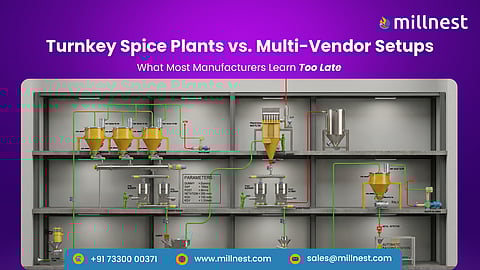
In the initial stages of setting up a spice processing facility, the spreadsheet often dictates the strategy. When comparing a Turnkey spice plant proposal with a "fragmented" approach—where the grinder comes from Vendor A, the conveyor from Vendor B, and the dust collector from Vendor C—the multi-vendor route usually looks cheaper on paper.
However, in industrial engineering, the "cheapest" path is often the most expensive in the long run.
Millnest frequently encounters manufacturers who reach out to them six months after commissioning their plant, frustrated by inconsistent throughput, recurring safety alarms, and a lack of accountability from their vendors. This article explores the hidden pitfalls of fragmented execution and why Execution Risk Reduction is only possible through an integrated turnkey model.
The "Integration Gap": Where Multi-Vendor Setups Fail
A spice plant is not a collection of independent machines; it is a single, breathing organism. If the "heart" (the mill) beats faster than the "veins" (the conveyors) can handle, the system suffers a stroke.
1. Mismatched Capacity and Flow
In a multi-vendor setup, Vendor A guarantees the mill will process 1 ton per hour. Vendor B guarantees the conveyor will move 1 ton per hour. But when they are connected, the "transition points" create bottlenecks. The airflow from the mill might interfere with the conveyor’s discharge, or the moisture in the spice might cause the product to bridge in a hopper designed by a vendor who didn't know the mill's heat profile.
2. The Control System Nightmare
This is the biggest hurdle in modern manufacturing. When you have four different vendors, you have four different control panels that don't talk to each other. Achieving a synchronized "Start-Stop" sequence becomes nearly impossible, leading to material pile-ups during emergency shutdowns.
Safety and Compliance: The ATEX Factor
When processing combustible materials like chili or turmeric dust, safety is non-negotiable. This is where Execution Risk Reduction becomes a matter of life and death.
A Turnkey spice plant from Millnest ensures that every component is part of a unified safety ecosystem. In a fragmented setup, you might buy ATEX certified processing equipment for the grinder, but if the rotary valve or the dust collector provided by a different vendor isn't compliant, the "chain" is broken.
The Millnest Turnkey Advantage:
Unified Safety Certification: Millnest ensures the entire line—from the feeding hopper to the bagging unit—is ATEX compliant.
Explosion Isolation: Millnest engineer the plant so that if a spark occurs in the mill, it is isolated by flame arrestors and valves before it can travel through the conveyors provided by "other" vendors.
Execution Risk Reduction: The Value of a Single Point of Contact
The term "Execution Risk" refers to everything that can go wrong between the day you sign the contract and the day you hit "Start" on your first commercial batch.
The Blame Game vs. Total Accountability
In a multi-vendor setup, when the system underperforms, Vendor A blames Vendor B’s installation, and Vendor B blames the raw material quality. The manufacturer is left caught in the middle.
With a Turnkey spice plant, the "Blame Game" is eliminated. Millnest take full responsibility for:
Engineering & Design: Ensuring the physics of the entire line is sound.
Procurement: Sourcing high-grade materials that match their engineering standards.
Installation & Commissioning: Synchronizing every motor and sensor.
After-Sales Support: One number to call for spares, maintenance, or optimization.
Performance Optimization: The Holistic View
A turnkey solution allows for specialized engineering that fragmented setups cannot offer, such as:
Integrated Dust Control: Millnest designs the dust collection system specifically for the airflow of its mills. This ensures a 100% dust-free spice grinding system that saves your yield and protects your workers.
Synchronized VFDs: Millnest program the Variable Frequency Drives so that the entire line accelerates and decelerates as one unit, preventing material surges and reducing energy waste.
Optimized Footprint: A turnkey provider can design a more compact layout, saving you significant costs in factory floor space and structural steel.
Conclusion: Buying Peace of Mind
The difference between a multi-vendor setup and a Turnkey spice plant is the difference between buying "parts" and buying "performance."
If you are a manufacturer looking to compete on a global scale, your focus should be on your product and your market—not on troubleshooting why Vendor A’s machine isn't talking to Vendor C’s sensor. By choosing an integrated partner like Millnest, you are not just buying ATEX certified processing equipment; you are buying the certainty that your plant will deliver the yield, quality, and safety you were promised.
Don't learn the lesson too late. Invest in a solution that is engineered to work together from day one.
Is your spice plant project ready for a turnkey upgrade?
Visit - millnest.com to see their successful installations and learn how they reduce execution risk for global food brands.
Click HERE to subscribe to our FREE Weekly Newsletter
