
- Home
- EventsEvents
- Product Launches
- CategoriesCategories
- Advertise
- Opinion

Farmers are the backbone of India’s agricultural economy, sustaining rural livelihoods and anchoring the country’s food and feed supply chains. Across Maharashtra’s soybean-growing regions, however, many are navigating a complex mix of agronomic and environmental pressures.
Limited access to up-to-date knowledge and best practices, from seed treatment to integrated pest and nutrient management, compounds challenges such as declining soil fertility and increasing pest pressures, threatening long-term productivity.
ADM’s success is closely tied to the success of farmers and the crops they grow. By strengthening agricultural resilience, ADM supports sustainable farming practices while helping to drive long-term value and stability across the supply chain. This commitment is reflected in its work across India, a region with significant potential to scale sustainable impact. Rather than approaching sustainability as a series of isolated initiatives, ADM focuses on strengthening inclusive systems that drive consistency, accountability and measurable outcomes across the value chain.
Under its Sustainable Agriculture Programme in India, ADM is driving systemic change through strategic collaborations and globally recognised standards. A notable example is ADM’s partnership with Bayer, launched in 2022 to strengthen sustainable soybean cultivation in Maharashtra. The initiative combines agronomic expertise, structured farmer training and improved market linkages, equipping farmers with practical, science-based guidance on soil health, crop planning and integrated pest management, while aligning farm-level practices with broader supply chain sustainability goals.
Complementing this on-ground support, ADM India’s operations are backed by five consecutive years of ProTerra certification[1], reflecting its ongoing commitment to responsible sourcing, environmental stewardship and social responsibility. This framework helps ensure that the programme’s sustainability practices align with internationally recognised standards while supporting long-term agricultural stability in the region.
Originally aiming to reach 25,000 farmers, the programme has already surpassed 53,000 certified farmers as of the end of 2025, and continues to scale towards a target of 100,000 by 2028. The experiences of Sharad Vinayak Beramde and Shivaji Narhari Dhumal, both certified under ProTerra, reflect two distinct entry points into the programme: one driven by the desire for increased agronomic insights, the other by the urgency to restore soil health.
Sharad Vinayak Beramde: From Fragmented Practices to Informed Farming
For Sharad Vinayak Beramde, joining the ADM India sustainable agriculture programme in 2020 was a deliberate step towards strengthening his understanding of soybean cultivation. Despite years of farming experience, he recognised gaps in his knowledge, particularly in areas such as seed treatment, integrated pest and nutrient management, and input purchasing decisions. More importantly, he was driven by a desire to understand the “why” behind each farming choice, not just the practice itself.
Through structured training, he began adopting more informed and systematic farming methods including planning inputs more carefully, managing crops with greater precision, and making decisions with clearer rationale.
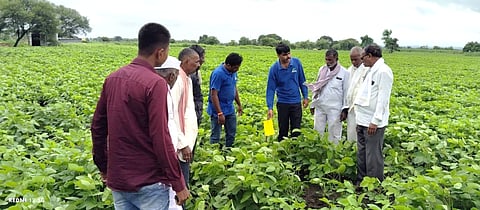
What set the programme apart from general agronomic methods was its emphasis on evidence rather than habit. Instead of routinely applying fertilisers and pesticides, the training encouraged need-based interventions guided by soil testing, crop stage assessment and Good Agricultural Practices (GAP), helping ensure more consistent product quality and reliability. The mindset shifted from “more input equals better yield” to using the right input at the right time. Demonstration plots, built around a “Seeing is Believing” approach, reinforced this learning by allowing farmers to observe real improvements in field conditions compared with standard control plots. Seeing the gains in yield and crop quality first-hand helped build confidence to adopt these practices on their own farms.
On his farm, this has translated into practical changes. He now routinely conducts soil testing, utilises deep and horizontal ploughing across slopes to reduce erosion, applies fully decomposed farmyard manure before harrowing, and improves overall farm maintenance to prepare land more effectively for sowing.
He has also implemented resource-efficient techniques such as Broad Bed Furrow (BBF) and dibbling, agricultural methods designed to improve crop production while reducing seed use and input costs. Today, these adjustments continue to contribute to lower production costs and improved yields. Equally significant has been a shift in financial discipline, with Sharad now systematically recording agricultural expenses, enabling tighter cost control and more informed planning for each growing season.
Reflecting on the changes he has seen, Sharad shares, “Previously, our yields were decreasing while costs continued to rise. Through the training, I was able to improve my production and manage expenses better. Since then, I’ve been encouraging other farmers in my community to adopt these practices so they can benefit as well.”
Sharad’s journey illustrates how the programme supports farmers not only in adopting improved techniques, but also in building confidence and long-term decision-making capabilities.
Shivaji Narhari Dhumal: Restoring Soil, Rebuilding Resilience
Unlike Sharad’s proactive entry, Shivaji Narhari Dhumal joined the programme in response to a pressing challenge. After 15 years of practicing traditional farming methods, he began to notice a steady decline in soil fertility on his land. Organic carbon levels in his fields had fallen from around 1% to just 0.3-0.4%, weakening crop resilience and affecting his long-term productivity.
Seeking practical solutions to restore soil health and manage pests while protecting input costs, Shivaji joined the initiative five years ago.
Through the programme, he has adopted integrated pest management (IPM) practices that reduce pest pressure while supporting soil biology. Sticky traps and pheromone traps now enable more precise pest monitoring and control, reducing the need for blanket chemical spraying. When intervention is necessary, targeted, lower-residue pesticides are used alongside mechanical control methods, helping to safeguard beneficial insects and soil biology.
He has also adopted seed treatment and germination testing, reducing pest and disease losses by 15% while reducing seed requirements per acre.
Alongside these pest management practices, Shivaji has also strengthened his fertiliser management approach. The introduction of Biomix into fertiliser management has enhanced nutrient absorption, improved microbial activity and reduced chemical fertiliser usage by 10-15%, leading to gradual improvements in soil structure that he continues to maintain today.
By combining balanced nutrient management with more targeted pest control, Shivaji has reduced his dependence on chemical inputs and strengthened the resilience of his crops against seasonal variability, pests and disease pressures. Regular training sessions and field demonstrations have further strengthened his confidence in applying these practices independently.
These combined interventions have translated into tangible outcomes. With improved yields and lower input costs, Shivaji’s farm income has increased by approximately 20%.
Reflecting on the transformation, Shivaji shares that he now farms “scientifically”, guided by soil data and crop needs rather than traditional practice or market speculation.
Shivaji’s experience demonstrates how regenerative practices can restore soil health while strengthening farm economics, linking immediate productivity gains with long-term environmental stewardship.
Strengthening Farms from the Ground Up
Together, the journeys of Sharad and Shivaji reflect a broader shift taking place at the farm level from relying primarily on inherited practices to making more data-informed decisions grounded in soil conditions and crop needs.
As environmental pressures and rising input costs continue to shape agricultural realities, such shifts may prove critical in sustaining both productivity and long-term land health across Maharashtra’s soybean-growing regions.
[1] https://www.proterrafoundation.org/news/adm-india-five-years-of-proterra-certification-advancing-sustainable-non-gmo-soy-and-strengthening-smallholder-livelihoods/
Click HERE to subscribe to our FREE Weekly Newsletter
