
- Home
- EventsEvents
- Product Launches
- CategoriesCategories
- Advertise
- Opinion

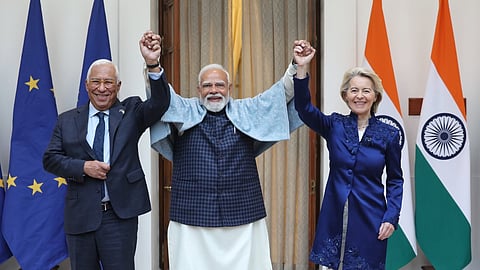
The conclusion of the India–European Union Free Trade Agreement marks a watershed moment for India’s food and agribusiness sector, opening one of the world’s most regulated and high-value food markets to Indian producers and processors. For the food industry, this agreement is not merely about tariff reduction—it represents access, credibility, scale, and long-term integration into global value chains.
With the EU being one of the largest importers of agri-food and processed food products globally, the FTA significantly enhances market access for Indian food exports such as tea, coffee, spices, marine products, fresh fruits and vegetables, ready-to-eat foods, bakery and confectionery items, nutraceuticals, and value-added processed foods. Reduction and elimination of tariffs improve price competitiveness, enabling Indian products to move from niche ethnic shelves to mainstream European retail and foodservice channels.
Equally important is the FTA’s focus on non-tariff measures, including streamlined Sanitary and Phytosanitary (SPS) procedures, regulatory transparency, and customs facilitation. These provisions address long-standing challenges faced by Indian food exporters, such as compliance costs, procedural delays, and regulatory unpredictability. Improved regulatory cooperation will help Indian food businesses align with EU food safety, traceability, sustainability, and quality standards—raising overall industry benchmarks.
For Indian farmers, food processors, and MSMEs, the agreement creates a level playing field and strengthens farm-to-fork value chains. Enhanced export opportunities translate into better price realization, reduced wastage, higher investments in food processing infrastructure, cold chains, packaging, and quality systems, and greater employment generation, particularly in rural and semi-urban areas.
The FTA also reinforces India’s positioning as a trusted global food supplier, especially at a time when supply chain resilience, food security, sustainability, and climate-compliant production are critical priorities for Europe. Safeguarding of sensitive sectors such as dairy and cereals ensures balanced growth, protecting domestic food security while promoting export-led expansion in competitive categories.
In essence, the India–EU FTA provides the Indian food industry with scale, stability, and global relevance—accelerating its transition from a commodity-led exporter to a value-driven, quality-focused, and innovation-oriented global food partner.
Click HERE to subscribe to our FREE Weekly Newsletter
