
- Home
- EventsEvents
- Product Launches
- CategoriesCategories
- Advertise
- Opinion

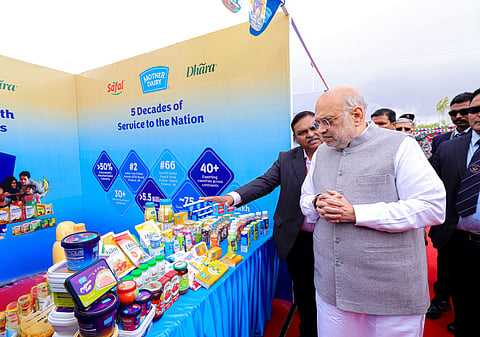
Union Home and Cooperation Minister Shri Amit Shah inaugurated a series of dairy infrastructure and cooperative initiatives in the Union Territory of Ladakh, marking a significant step towards strengthening the region’s livestock economy and rural livelihoods.
The event was attended by Union Minister of Fisheries, Animal Husbandry and Dairying Shri Rajiv Ranjan Singh alias Lalan Singh, Ministers of State Shri S. P. Singh Baghel and Shri George Kurian, and Lieutenant Governor of Ladakh Shri Vinay Kumar Saxena.
Dairy infrastructure expansion to empower local communities
Addressing the gathering, Shri Amit Shah highlighted that under the cooperative model envisioned by Prime Minister Shri Narendra Modi, multiple development programmes are being implemented simultaneously in Ladakh.
He announced the foundation stone laying of a 10 TLPD (10,000 litres per day) dairy plant in Kargil, stating that the ₹25 crore project will play a transformative role in empowering women and enhancing rural incomes. He emphasised that similar small-scale dairy initiatives in other regions have enabled women to achieve significant economic success, and expressed confidence that women in Ladakh can replicate this progress.
He also noted that daily production has commenced at the milk plant already operational in Leh.
Strengthening supply chains and quality infrastructure
Shri Shah pointed out that Ladakh’s strategic presence of around 18,000 Army and ITBP personnel creates strong local demand for dairy products such as milk, curd, and paneer, which the new infrastructure aims to fulfil.
To ensure quality and efficiency, a mobile laboratory worth ₹45 lakh has been launched, alongside an Android-based Automatic Milk Collection System (AMCS) application. The app enables dairy farmers to transparently track their milk procurement data, improving trust and operational efficiency.
He also felicitated five livestock farmers, recognising them as role models for the region.
Market integration through cooperative partnerships
A key highlight of the event was the agreement between the Ladakh Milk Federation and Mother Dairy, aimed at connecting Ladakh’s dairy products to national markets. Shri Shah emphasised the need to provide Ladakh’s organic products access to large consumer markets such as Delhi.
He further urged the National Dairy Development Board (NDDB) to facilitate a tripartite MoU with the National Cooperative Organic Limited to strengthen market linkages and ensure wider distribution of Ladakh’s products through cooperative networks.
Future roadmap: Scaling capacity and livestock development
Outlining the long-term vision, Shri Shah announced plans to establish a 50,000 litres per day dairy plant in Leh at an estimated cost of ₹70 crore. This facility will complement the Kargil plant and support rising milk production in the region.
He also announced initiatives to boost livestock productivity, including the annual introduction of approximately 500 high-yield, climate-resilient cattle breeds suited to Ladakh’s extreme conditions. A long-term target has been set to nearly triple the livestock population over the next decade.
Currently, the dairy cooperative network has expanded to 28 villages, connecting around 1,700 milk producers. Shri Shah urged NDDB to further expand its reach to maximise participation and improve farmer livelihoods.
Rising milk production and cooperative expansion
Shri Shah stated that daily milk procurement in the region has reached approximately 7,000 kilolitres, with a target to increase it to 21,000 kilolitres over the next four years. He also noted that an existing dairy plant has been upgraded, doubling its capacity from 5 TLPD to 10 TLPD.
Highlighting national achievements, he said India’s milk production has grown from 146 million tonnes in 2014–15 to 248 million tonnes in 2024–25, marking a 70% increase in a decade. Per capita milk availability has also risen from 307 grams to 485 grams.
This growth, he added, has been driven by over 2.36 lakh cooperative societies and nearly 2 crore milk producers. The government aims to establish 75,000 new milk societies in five years, of which 21,000 have already been formed.
Holistic development of Ladakh since Union Territory status
Shri Shah highlighted the broader developmental progress in Ladakh since it became a Union Territory in 2019. The region now comprises seven districts and 193 panchayats, with five new districts recently notified.
He detailed significant infrastructure improvements, including expansion of road networks, bridges, mobile connectivity, electrification, and snow management systems. Major projects such as the Zoji La tunnel, Shinkula tunnel, and a new civilian airport are underway, alongside advancements in education, digital connectivity, and water supply under the Jal Jeevan Mission.
He noted that Ladakh is on track to become a fully literate administrative unit, supported by initiatives such as ICT labs, smart classrooms, and Atal Tinkering Labs.
Towards a self-reliant and cooperative-driven Ladakh
Emphasising the importance of cooperative-led growth, Shri Amit Shah urged the Ladakh administration to tap the full potential of dairy and animal husbandry across all feasible villages. He also announced plans to establish cooperatives for pashmina, organic products, and honey.
He stated that Ladakh’s budget has increased significantly from ₹1,000 crore to ₹6,000 crore, reflecting the government’s focus on the region’s development. The establishment of the Sindhu Infrastructure Development Corporation is expected to further boost industrial growth.
Concluding his address, Shri Shah expressed gratitude to the people of Ladakh and Kargil for their unwavering patriotism and contributions to national security, reaffirming the government’s commitment to making the region self-reliant and economically robust.
Click HERE to subscribe to our FREE Weekly Newsletter
